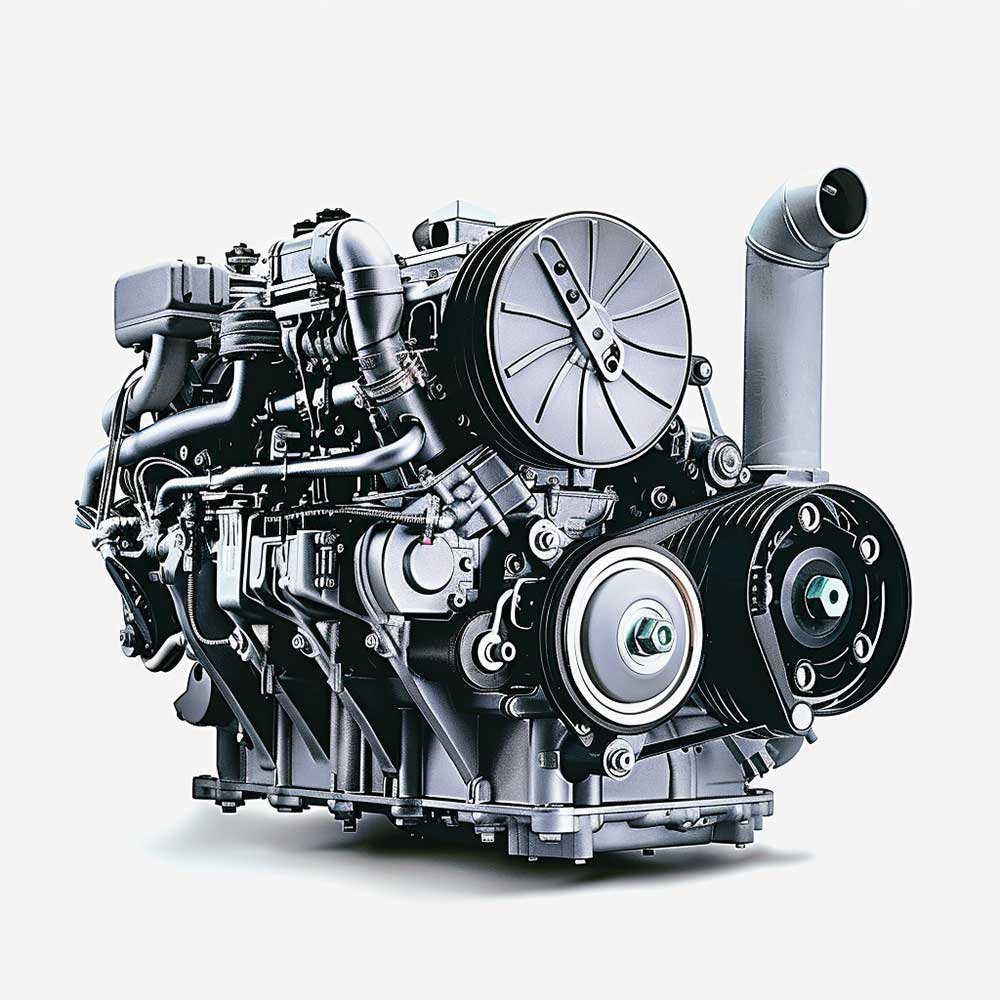
Deutz engines have a reputation for running on a lick of diesel and a bit of optimism. Air-cooled 912s and 913s have pumped boreholes, pulled planters and powered generators across South Africa for decades. But even a tough engine has one weakness: being ignored. A proper Deutz engine service is the cheapest insurance you can buy. This guide gives you the intervals, a checklist you can tick off in the shed, the oil to use and the parts worth keeping on the shelf.
- Older naturally aspirated 912/913 engines: change the oil every 500 hours with CH-4 / ACEA E3 grade oil, or every 250 hours with lower grades. Turbo engines need half that.
- Halve those intervals if the engine runs in severe cold (below −10 °C for long periods), and change the oil at least once a year no matter what the hour meter says.
- On an air-cooled Deutz, the cooling fins are the radiator. On farm machines Deutz suggests cleaning them as often as every 125 hours.
- Valve clearance on the 912/913 is 0.15 mm for both inlet and exhaust, set on a cold engine.
- Keep filters, a V-belt and a set of gaskets on the shelf. A cheap part sitting on the shelf beats an expensive breakdown in the middle of harvest.
Why a Deutz engine service matters more than you think
Most Deutz engines don’t die suddenly. They get tired slowly. A clogged air filter lets dust in, and dust wears the liners. Old oil turns to sludge. Dirty fins trap heat until a cylinder head cracks. By the time the engine smokes, knocks or won’t start, the bill has grown from a filter to an overhaul.
South African conditions don’t help. Think dusty dry-land fields, long hot days on the pump, machines that stand still for months between seasons and then have to work flat out. Deutz itself says its maintenance intervals are maximums, and that harsh conditions can call for shorter ones. In other words, the hours in the manual are the ceiling, not the target.
Step one: know exactly which engine you have
You can’t service an engine properly if you don’t know what it is. Every Deutz has a rating plate on the crankcase, and some have a second plate on the air duct. It shows the engine model and serial number. The serial number is also stamped into the crankcase itself, which is handy when the plate has been painted over or knocked off. Write both down and keep them in your phone. You’ll need them every time you order parts.
The model code looks like alphabet soup, but it’s actually quite logical:
| Letter or number | What it means | Example |
|---|---|---|
| F | High-speed four-stroke engine | F4L 912 |
| Digit after F | Number of cylinders | F4L 912 = four cylinders |
| L | Air-cooled (luftgekühlt) | F4L 913 |
| M | Liquid-cooled | BF4M 1013 |
| B (in front) | Turbocharged | BF6L 913 |
| C (at the end) | Charge air cooler | BF6L 913C |
| Last three or four digits | Engine series | 912, 913, 413, 1011, 2011 |
That “B” matters more than you’d think. A turbocharged engine works its oil harder, so its oil-change interval is shorter, as you’ll see in the next section.
Deutz engine service intervals at a glance
Here are the oil-change intervals from the operation manual for the 912 and 913 series. These are the engines we see most on South African farms. The interval depends on two things: whether the engine is turbocharged, and the quality of the oil you put in.
| Engine type | Oil quality | Oil change every | In severe cold |
|---|---|---|---|
| Naturally aspirated (F…L 912 / 913) | API CH-4 / CG-4 or ACEA E3 and better | 500 hours | 250 hours |
| Naturally aspirated (F…L 912 / 913) | API CF-4 or ACEA E1–E2 | 250 hours | 125 hours |
| Turbocharged (BF…L 913) | API CH-4 / CG-4 or ACEA E3 and better | 250 hours | 125 hours |
| Turbocharged (BF…L 913) | API CF-4 or ACEA E1–E2 | 125 hours | 63 hours |
Newer liquid-cooled compact engines (the 2011, TCD and similar ranges) can run much longer between changes if you use the correct Deutz-approved oil. Deutz’s own technical circular on operating fluids sets the ceiling at 1,000 operating hours within one year for its compact engines. Your engine’s own manual and its oil quality class decide where you land below that.
Brand-new or freshly rebuilt engine? The first service comes early, after 50 to 150 operating hours. That’s when new parts bed in, so change the oil and filter, check for leaks and look at the valve clearance. Skipping this one is a false economy.
When is your next oil change due?
Hour meters and memory don’t always agree. Enter your numbers below and let the calculator do the sums.
Based on the 912/913 operation manual. For other engines, use your own manual’s interval.
The Deutz engine service checklist
Print this out, stick it on the shed wall, or tick it off on your phone right here. Your progress bar fills up as you go.
Every day (or every 10 operating hours)
At every oil service
Valve clearance: small gap, big difference
Valve clearance is checked at the intervals in your manual, and after the first 50 to 150 hours on a new or rebuilt engine. On the 912 and 913 it’s 0.15 mm (with a tolerance of +0.05 mm) for both inlet and exhaust. Let the engine cool for at least 30 minutes first, until the oil is below 80 °C. If the gap is too tight, the valves can burn. Too loose, and you get a tappety clatter and lost power. If you’re replacing rocker cover gaskets while you’re in there, our gaskets and seals range covers the common Deutz sets.
Mechanic’s tip: Take a photo of the engine before you start, and another of every hose and wire you unplug. It’s amazing how different an engine looks once you’ve had your head in it for an hour.
The air filter rules (don’t skip these)
Dust is the silent engine killer on South African farms. Deutz’s rules for dry-type filters are clear:
- Clean the main cartridge only when the indicator or warning light says so. Over-cleaning damages the paper.
- Blow it out from the inside out with dry compressed air at no more than 5 bar.
- Never wash it in petrol or hot liquids.
- Replace the inner safety cartridge after five services of the main filter, or after two years at the latest. Never clean the safety cartridge.
- Oil-bath cleaners get topped up with engine oil to the mark. Cyclone pre-cleaners just get emptied, never filled with oil.
Need help choosing a replacement? Here’s our guide to picking the right air filter for a Deutz tractor.
Air-cooled Deutz engines: fins, fans and V-belts
An air-cooled Deutz has no radiator to boil over, which is exactly why owners love them. But the job the radiator would do is done by the cylinder and head fins and the oil cooler, and they only work if air can actually get through them. Chaff, oily dust and the odd bird’s nest can block them surprisingly fast.
Deutz says the right cleaning interval depends on how the engine is used. It ranges from 2,000 hours for engines in clean, enclosed spaces down to 125 hours for agricultural and harvesting machinery. With the engine stopped and the electrics covered, you have three options:
- Compressed air: blow through from the exhaust side, taking care not to bend the fins.
- Cold cleaner: spray it on, leave it for about 10 minutes, then rinse off with a water jet. Run the engine afterwards to dry it out.
- Steam: maximum 60 bar and 90 °C, then run the engine warm to dry it.
Snapped V-belt? Switch off immediately. On an air-cooled Deutz, the belt drives the cooling fan. No belt means no cooling, and the engine can cook itself in minutes. Keep a spare belt like this double 10×1375 V-belt in the toolbox, and re-check the tension after about 15 minutes of running a new one under load.
If the temperature gauge keeps creeping up, the usual suspects are a blocked oil cooler, a loose or broken belt, damaged or missing cooling air guides, or an oil level that’s too low or too high. Our article on how the Deutz cooling system works goes deeper, and air, cooling and exhaust parts are in stock if something needs replacing.
Choosing the right oil (and a word on South African diesel)
For the older 912 and 913 engines, pick the viscosity (the SAE grade, such as 15W-40) by the temperature where the engine starts, not by the summer peak. If it occasionally gets colder than the oil’s range, Deutz says cold starting may be harder but the engine won’t be damaged. Then choose the quality grade. CH-4 / ACEA E3 or better earns you the longer intervals in the table above.
Newer Deutz engines use the company’s own DEUTZ Quality Class (DQC) oil system, which runs from DQC I for older engines with shorter intervals up to DQC III and IV for high-performance engines. Low-ash (LA) versions exist for engines with exhaust after-treatment. Match the class to your manual and you can’t go far wrong. For brand comparisons, see our rundown of the best engine oil for Deutz engines, or browse lubricants and oils and lubrication system parts.
Local knowledge: The oil-change table above assumes diesel with no more than 0.5% sulphur. South Africa’s pump diesel is far cleaner than that. The two common grades are 500 ppm (0.05%) and 50 ppm (0.005%), as set out in the national diesel standard, SANS 342. So for older mechanical 912/913 engines, sulphur isn’t a reason to shorten your intervals. Newer engines with exhaust after-treatment are a different story. Use the fuel their manual specifies.
Fuel cleanliness matters more than sulphur. Water and dirt in the tank are what ruin injectors. If you notice hard starting, smoke or a rough idle, read up on Deutz fuel injector symptoms before replacing parts at random.
The Deutz service parts worth keeping on the shelf
Breakdowns never happen on a quiet Tuesday. They happen on the Saturday before planting. A small stock of service parts turns a lost week into a lost hour.
| Part | Why keep a spare | Where to find it |
|---|---|---|
| Oil filter cartridges | Needed at every oil change. Running an old filter is false economy. | Lubrication system |
| Fuel filter / pre-filter | Dirty fuel is the number one cause of injector trouble | Fuel system |
| V-belt | On air-cooled engines, a snapped belt stops the cooling fan | V-belt 10×1375 double |
| Rocker cover and sump gaskets | Cheap to keep, and annoying to wait for once the cover is off | Gaskets and seals |
| Injector nozzle | A worn nozzle causes smoke, knocking and high fuel use | Nozzle (long) |
| Engine oil (20 l or more) | So the next service never waits for a trip to town | Lubricants and oils |
Running a fleet of 912s or 913s? It’s worth browsing the full Deutz 912 engine parts and Deutz 913 engine parts ranges, or the broader air-cooled engine parts and liquid-cooled engine parts sections. If you’re new to ordering, here’s how to buy the right Deutz parts in South Africa without the guesswork.
DIY or workshop? Know when to call in help
Oil, filters, belts, fins and air cleaners are well within reach of a handy farmer or operator with the right tools. A few signs mean it’s time to stop and get a mechanic involved:
- Blue smoke (burning oil), white smoke that doesn’t clear when the engine warms up, or heavy black smoke under load.
- Low oil pressure, or oil turning milky or smelling of diesel.
- Overheating that continues after the fins are clean and the belt is right.
- Knocking, loss of compression or hard starting even with good fuel and a strong battery.
- Charging problems. Our Deutz alternator compatibility guide helps if the alternator is the culprit.
For diagnosis, start with our guide to common Deutz engine problems and their fixes. If the engine is too far gone, a new or reconditioned Deutz engine can make more financial sense than another rebuild.
Deutz engine service: frequently asked questions
How often should a Deutz engine be serviced?
For the older air-cooled 912 and 913 engines, plan an oil and filter service every 500 hours (naturally aspirated, CH-4 / E3 oil) or 250 hours (turbo, or lower-grade oil). Do daily checks every time you use the machine, and change the oil at least once a year. Newer compact engines can go longer with Deutz-approved oils, up to a maximum of 1,000 hours within one year.
What oil does a Deutz 912 or 913 take?
A diesel engine oil of at least API CF-4 / ACEA E2 quality, with the SAE viscosity chosen for the temperature at which the engine starts. A multigrade such as 15W-40 is common. Using CH-4 / ACEA E3 or better lets you run the longer 500-hour interval on naturally aspirated engines.
What is the valve clearance on a Deutz 912 and 913?
0.15 mm (+0.05 mm) for both inlet and exhaust valves, set on a cold engine. Let it cool for at least 30 minutes, with the oil below 80 °C, before checking.
Can I run my Deutz on 500 ppm diesel?
Older mechanical 912 and 913 engines are designed for fuel with up to 0.5% sulphur without shortening the oil-change interval, and 500 ppm diesel is only 0.05%. Newer engines with exhaust after-treatment usually need low-sulphur diesel. Always follow your engine’s manual.
How do I know which Deutz engine I have?
Look for the rating plate on the crankcase (some engines have a second one on the air duct). It shows the model, such as F4L 912, and the serial number. The serial number is also stamped into the crankcase. Quote both when you order parts.
Why does my air-cooled Deutz overheat?
The most common causes are blocked cooling fins or a blocked oil cooler, a loose or broken V-belt, damaged or missing cooling air guides, and an oil level that’s too low or too high. Clean the fins and check the belt first. Those two fix most cases.
Estorf Teile has supplied Deutz engine parts to farmers, workshops and plant owners across South Africa since 2011. Send us your engine model and serial number, and we’ll put together the right filters, belts and gaskets for your next service.
Request a service parts quoteBrowse the parts catalogueSources: Deutz 912/913 operation manual (maintenance schedule, oil-change intervals and technical data); Deutz Technical Circular 0199-99-01119; DEUTZ Quality Class. Intervals vary by engine and application, so always check your engine’s operation manual.